Workflows
Product Marketing Manager Burnout: The Silent Cost of Constant Slack and GTM Chaos
Product marketing burnout isn’t about long hours. It’s about Slack overload, reactive work, and GTM lag that’s quietly damaging your revenue engine.
Introduction: The Unseen Burden of the PMM
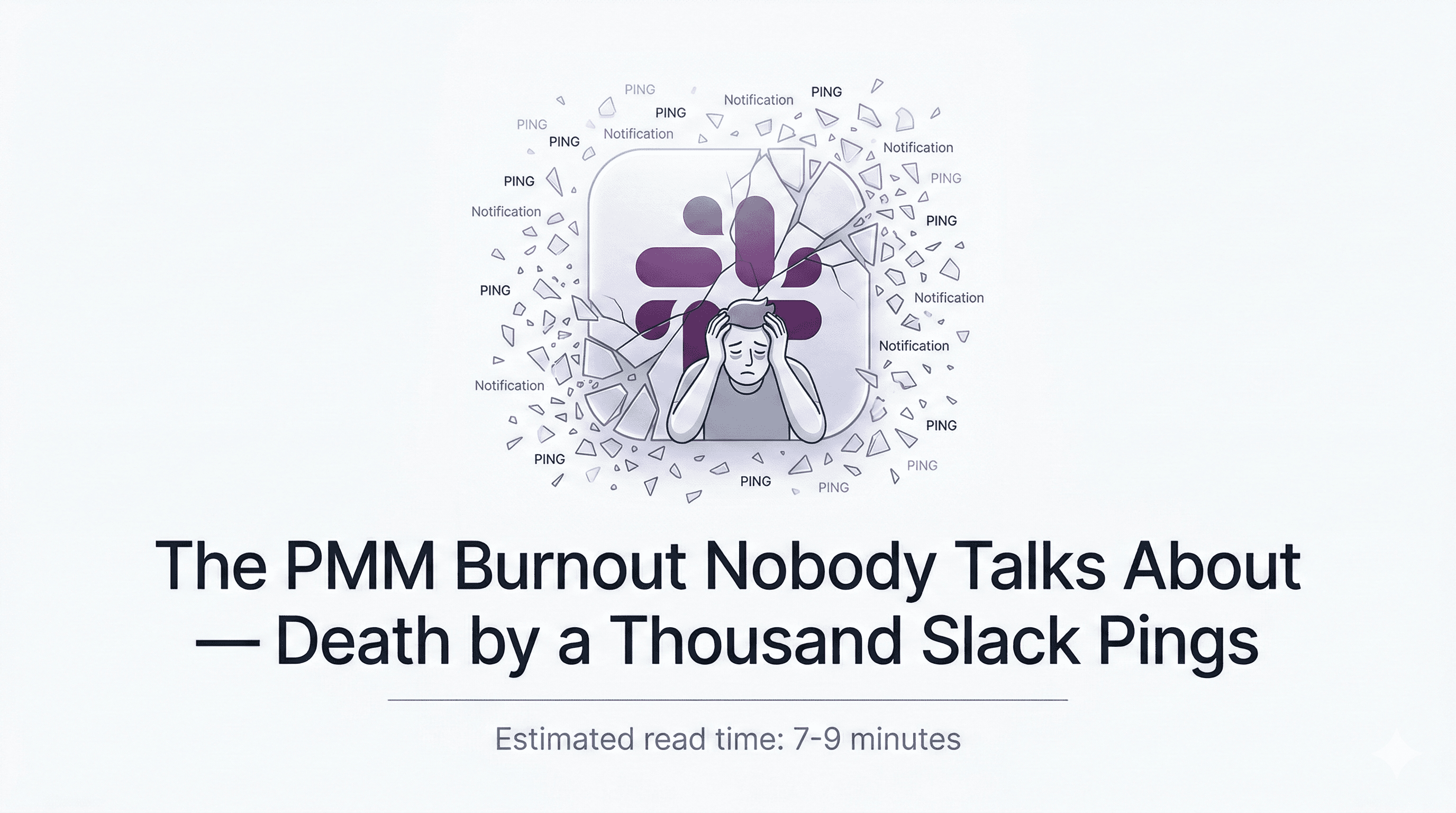
Product marketing managers (PMMs) are often lauded as the strategic orchestrators of product success, the critical link between innovation and market adoption. They are expected to be market experts, product evangelists, sales enablers, and strategic communicators, all rolled into one. However, beneath the veneer of strategic influence lies a silent epidemic: PMM burnout. This isn't the dramatic, visible burnout of a startup founder working 100-hour weeks, but a slow, insidious drain caused by constant context switching, endless information requests, and the relentless pressure to keep pace with a fast-moving product. This "death by a thousand Slack pings" is a significant factor contributing to Go-to-Market (GTM) lag, as exhausted PMMs struggle to maintain the strategic clarity and proactive execution necessary for effective market launches.
The "Human Router" Syndrome: Always On, Always Reacting
PMMs occupy a unique position at the nexus of multiple departments. They are the go-to source for product information for sales, the market voice for product, and the strategic guide for marketing campaigns. This central role, while empowering, often transforms them into a "human router," constantly redirecting information, answering questions, and resolving communication breakdowns. The primary tool for this constant interaction? Instant messaging platforms like Slack. What begins as a convenient way to collaborate quickly morphs into a relentless stream of notifications, each demanding immediate attention.
This constant state of being "on" and reactive leads to a phenomenon known as context switching, where the brain is forced to rapidly shift focus between disparate tasks. Each switch incurs a cognitive cost, reducing efficiency and increasing mental fatigue. Over time, this wears down a PMM, making it difficult to engage in the deep, strategic thinking required for effective product positioning and market analysis. The Product Marketing Alliance (PMA) highlights that 44.3% of PMM teams consist of only 1-2 people, often working at a 1:3 ratio with product management . This lean structure means PMMs are often stretched thin, making them particularly vulnerable to communication overload and the resulting burnout. Gartner's 2025 research also indicates that 63% of executives underestimate the strategic value of product marketing, viewing it merely as collateral production or campaign support , which can lead to PMMs being overloaded with tactical communication and less strategic support.
Real-World Scenario: The Weekend That Wasn't
Consider Chloe, a PMM who prided herself on her ability to juggle multiple product launches simultaneously. However, the constant stream of Slack messages—from engineers clarifying a feature, from sales asking for a last-minute competitive analysis, from leadership requesting an urgent update—meant her workdays were a blur of reactive tasks. She found herself working late into the evenings and often through weekends, just to catch up on the strategic work that required uninterrupted focus. One Saturday morning, while trying to draft a critical messaging framework, she received over 30 Slack notifications within an hour, each pulling her away from her task. By the end of the weekend, she had made little progress on her strategic work and felt utterly drained. This constant interruption and the inability to disconnect is a classic symptom of PMM burnout, directly impacting her ability to proactively drive GTM initiatives and contributing to GTM lag. The PMA's 2024 report indicated that 5.9% of product marketers wish to change their career and company entirely, often due to burnout and unclear paths .
The Silent Killer: Impact on GTM Effectiveness and Innovation
PMM burnout is not just a personal issue; it has profound implications for the entire organization. When PMMs are exhausted and overwhelmed, their strategic output diminishes. They become less effective at crafting compelling narratives, identifying market opportunities, and enabling sales teams. This directly contributes to GTM lag, as the marketing efforts struggle to keep pace with product development, leading to missed market windows and suboptimal product adoption. MarTech reported in 2025 that GTM effectiveness has fallen from 78% in 2018 to a mere 47% in 2025 , a decline that can be partly attributed to the internal communication challenges and burnout experienced by key GTM roles. MarketBridge's 2025 report also points to a growing gap between economic expectations and AI-driven GTM transformation, further emphasizing the need for streamlined processes and healthy teams .
Furthermore, burnout stifles innovation. A PMM who is constantly reacting to pings and requests has little mental space for creative thinking, strategic planning, or exploring new market angles. This can lead to generic messaging, a lack of differentiation, and ultimately, a product that struggles to stand out in a crowded market. The long-term consequences include high turnover rates among PMMs, loss of institutional knowledge, and a weakened GTM function. Forrester's 2024 report on the state of business buying emphasizes the need for providers to transform their GTM approach and understanding of buyer needs , which is difficult with a burnt-out PMM team.
Combating the Burnout: Strategies for Sustainable PMM Roles
Addressing PMM burnout requires a systemic approach that goes beyond individual coping mechanisms. Organizations need to recognize the unique pressures PMMs face and implement strategies to create more sustainable roles. This includes establishing clear communication guidelines and expectations, encouraging asynchronous communication, and creating dedicated "focus time" where PMMs can engage in deep work without interruption. Tools that centralize product information and reduce the need for constant back-and-forth can also be invaluable. Forrester's 2025 B2B Summit North America, with its theme of "GTM Singularity," emphasizes unifying marketing, sales, product, and customer success under one GTM vision, highlighting the importance of integrated efforts .
Empowering PMMs to set boundaries is also crucial. This means supporting them in saying "no" to non-essential meetings or requests that fall outside their strategic purview. Investing in automation for routine tasks, and providing adequate staffing for PMM teams, can also alleviate the burden. The PMA's 2025 report highlights that Sales Enablement rose from 64% in 2024 to nearly 79% in 2025 , indicating the increasing importance of well-prepared sales teams, which PMMs are central to. Aligned GTM teams are twice as likely to exceed their commercial targets , and a healthy, engaged PMM team is fundamental to achieving that alignment. The rise of AI in GTM strategies, with over 70% of B2B organizations expected to rely heavily on AI-powered GTM by the end of 2025 , also suggests that AI can be leveraged to automate some of the communication overhead, freeing up PMMs for more strategic tasks and reducing burnout.
Practical Takeaway: Prioritize Focus, Protect the Strategic Mindset
PMM burnout, often fueled by the relentless barrage of digital communication, is a silent threat to GTM effectiveness. By recognizing the unique challenges PMMs face and implementing strategies that prioritize focused work, clear communication, and sustainable workloads, organizations can protect their PMMs from burnout. This not only fosters a healthier work environment but also ensures that product marketing can operate at its strategic best, effectively closing the GTM lag and driving market success. This proactive approach aligns with the growing trend of product-led growth, where 41% of companies now lead with product, up from 31% in 2024 .
About Shiplog
If this resonated…
We built ShipLog specifically to eliminate GTM lag caused by manual product-to-market translation.
Instead of reacting to Slack pings, PMMs get structured, automated activation the moment product changes.
See how it works:
👉 https://calendar.app.google/C3xHb99xQgrfUMjm9
References
[1] Romain Bauer (2025). 3 Priorities Product Marketing Leaders Must Act on in 2025. Medium. [
[2] Gartner (2025 ). Top Trends for Tech Providers in 2025. [
[3] Product Marketing Alliance (2025 ). State of Product Marketing Report 2025. [
[4] MarTech (2025 ). The future of GTM starts with causal clarity. [
[5] MarketBridge (2025 ). Report card: Grading 2025 GTM predictions. [
[6] Gartner (2025 ). AI in Sales 2025: Statistics, Trends & Generative AI Insights. [
[7] Tapistro (2025 ). The Future of GTM: How AI-Orchestrated Strategies Will Dominate in 2025. [
[8] Forrester (2025 ). B2B Summit North America: GTM Singularity. [
[9] Forrester (2024 ). The State Of Business Buying, 2024. [
[10] Product Marketing Alliance (2024 ). State of Product Marketing Report 2024. [
[11] Fluvio Marketing (2024 ). Facilitation at Scale summary of PMA report. [
[12] Lenny's Newsletter (2025 ). The definitive guide to mastering product sense interviews. [
About Shiplog
If this resonates, ShipLog was built for exactly this problem. See how it works: useshiplog.com
View more articles
Learn actionable strategies, proven workflows, and tips from experts to help your product thrive.